
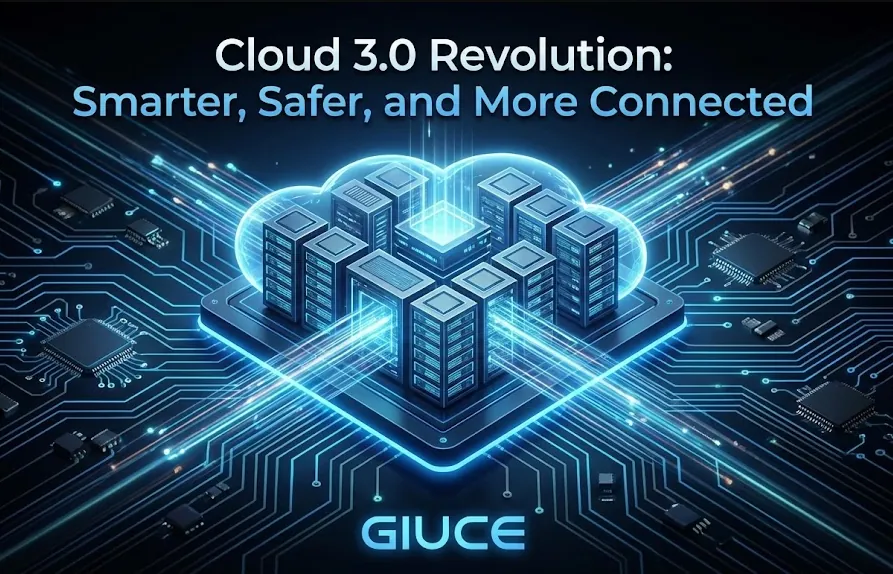
The Dominant Cloud 3.0 Smarter and Safer Connected Future represents an architectural transition from centralized elastic infrastructure into adaptive distributed intelligence layers. This phase integrates autonomous orchestration zero trust security primitives and persistent interconnection across edge core and sovereign domains. Cloud computation no longer functions as rented capacity but as a continuously learning substrate coordinating data flow identity enforcement and system resilience. The transformation restructures how computation authority latency tolerance and risk boundaries are defined across digital ecosystems.
Cloud 3.0 environments internalize intelligence at the infrastructure level. Policy inference workload placement and security posture adjustment occur without human scheduling. This produces deterministic performance envelopes under variable demand. Research from the Cloud Native Computing Foundation demonstrates that self orchestrating systems reduce failure propagation while increasing deployment velocity.
Dominant Cloud 3.0 Smarter and Safer Connected Future Architecture Shift
From Virtualization to Cognitive Fabric
Earlier cloud generations emphasized virtualization and containerization. Cloud 3.0 replaces static abstraction with cognitive fabric. Infrastructure layers embed inference engines that interpret workload intent rather than explicit configuration. Dominant Cloud 3.0 Smarter and Safer enables automatic topology reshaping based on real time signals. Academic surveys published through IEEE Xplore describe this shift as intent driven infrastructure.
Policy Defined Execution
Execution parameters such as latency tolerance data locality and compliance boundaries are expressed as policy. The platform resolves these policies dynamically. This reduces configuration debt and minimizes human error. Policy driven execution aligns with research on declarative systems referenced by ACM Digital Library.
Continuous State Awareness
State awareness extends beyond resource utilization into dependency integrity trust status and anomaly likelihood. Continuous awareness allows preemptive isolation of unstable components. This capability underpins resilient distributed operations at scale.
Intelligent Resource Orchestration
Autonomous Workload Placement
AI schedulers evaluate compute cost energy consumption latency and security context simultaneously. Workloads migrate across regions and edges without service interruption. Cloud providers implementing these mechanisms report improved efficiency as documented by Google Cloud Architecture Center.
Elasticity Beyond Scaling
Elasticity evolves from simple scale up scale down mechanics into adaptive restructuring. Services split merge or relocate based on behavior patterns. Dominant Cloud 3.0 Smarter and Safer form of elasticity maintains performance invariants under unpredictable demand.
Energy Aware Computing
Cloud 3.0 integrates energy telemetry into orchestration decisions. Workloads shift toward lower carbon intensity regions when policy permits. Sustainability studies from the International Energy Agency link intelligent workload placement to measurable emission reduction.
Dominant Cloud 3.0 Smarter and Safer Security as a Native Property
Zero Trust Embedded Enforcement
Security transitions from perimeter defense to continuous verification. Identity device posture and behavioral context are validated per transaction. Zero trust models outlined by NIST form the baseline for Cloud 3.0 security design.
Self Healing Security Controls
Detection of compromise triggers automated containment and remediation. Dominant Cloud 3.0 Smarter and Safer includes credential rotation network segmentation and workload redeployment. Autonomous response reduces dwell time and limits blast radius.
Cryptographic Isolation at Scale
Confidential computing enclaves protect data in use. Hardware based isolation ensures computation confidentiality even from infrastructure operators. Research summarized by Microsoft Azure Confidential Computing highlights adoption of enclave based execution.
Hyperconnected Edge and Core Integration
Edge Native Cloud Extension
Edge nodes operate as first class cloud participants. They host inference data filtering and localized control loops. Latency sensitive applications such as industrial automation rely on this integration. Standards bodies like the ETSI define frameworks for edge cloud convergence.
Data Gravity Resolution
Cloud 3.0 resolves data gravity by moving computation toward data rather than centralizing storage. This reduces bandwidth load and compliance risk. Distributed data processing models align with findings from MIT CSAIL.
Persistent Connectivity Mesh
Connectivity shifts from point to point links into persistent mesh architectures. Services discover and authenticate each other dynamically. Dominant Cloud 3.0 Smarter and Safer mesh sustains operation under partial network failure.
Governance Compliance and Sovereignty
Policy Aware Data Residency
Regulatory constraints are encoded into orchestration logic. Data residency and processing locality are enforced automatically. Compliance frameworks published by the European Data Protection Board influence these mechanisms.
Auditability by Design
Every system action generates verifiable logs. Audit trails support regulatory review without manual reconstruction. Immutable logging architectures leverage append only storage validated through cryptographic proofs.
Sovereign Cloud Domains
Cloud 3.0 supports sovereign domains where control remains within national or organizational boundaries. Interoperability occurs through controlled gateways. Policy discussions from the OECD emphasize sovereignty as a core cloud evolution driver.
Dominant Cloud 3.0 Smarter and Safer Developer Interaction Model Transformation
Intent Centric Development
Developers specify desired outcomes rather than infrastructure details. The platform resolves execution. This reduces cognitive load and accelerates iteration. Research into intent based systems by Stanford Computer Science supports this paradigm.
Continuous Verification Pipelines
Build pipelines integrate security and compliance verification at every stage. Failures trigger automated correction or rollback. Dominant Cloud 3.0 Smarter and Safer embeds governance into delivery workflows.
Reduced Operational Burden
Operations teams transition from manual maintenance to oversight of automated systems. Human effort focuses on policy refinement and anomaly investigation.
Economic and Systemic Impact
Dominant Cloud 3.0 Smarter and Safer Cost Predictability
Autonomous optimization stabilizes cost structures. Variance caused by over provisioning and reactive scaling diminishes. Financial analyses from Gartner associate automation with improved cloud cost governance.
Resilience as Default
System resilience emerges from continuous adaptation rather than redundancy alone. Failures are absorbed and corrected dynamically. Dominant Cloud 3.0 Smarter and Safer changes risk modeling assumptions across industries.
Platform Level Innovation Acceleration
Cloud 3.0 abstracts complexity to the infrastructure layer. Innovation shifts upward into application logic and data interpretation. This accelerates experimentation without increasing operational fragility.
Interoperable Multi Cloud Intelligence
Dominant Cloud 3.0 Smarter and Safer Cross Domain Orchestration
Cloud 3.0 coordinates workloads across multiple providers and private domains. Decision engines evaluate jurisdiction cost and performance. This avoids vendor lock while preserving optimization.
Federated Identity Resolution
Identity systems interoperate across clouds. Trust is established through federated credentials and continuous verification. Standards from the OpenID Foundation enable this interoperability.
Unified Observability
Observability spans clouds edges and networks. Metrics traces and logs feed unified inference models. This supports holistic system reasoning rather than fragmented monitoring.
Data Intelligence Embedded Infrastructure
Real Time Analytics Fabric
Analytics pipelines operate continuously rather than in batch cycles. Insights emerge as data flows. Platforms like Apache Flink exemplify stream native processing aligned with Cloud 3.0.
Machine Learning Lifecycle Integration
Model training deployment and monitoring are native infrastructure functions. Drift detection and retraining occur automatically. This embeds learning systems into operational fabric.
Privacy Preserving Computation
Techniques such as federated learning and homomorphic encryption allow insight extraction without raw data exposure. Research from OpenMined advances privacy preserving analytics.
Network Evolution Under Cloud 3.0
Software Defined Wide Area Integration
Networks become programmable and adaptive. Traffic routes adjust based on latency congestion and security posture. SD WAN research from Cisco documents performance gains through software control.
Application Aware Routing
Routing decisions consider application requirements. Critical flows receive priority without manual configuration. This improves service consistency.
Failure Tolerant Topologies
Network topologies reconfigure under fault conditions. Mesh based designs sustain connectivity even with node loss.
Automation Ethics and Control
Human Override Frameworks
Despite automation control remains interruptible. Clear override mechanisms ensure human authority. Governance models discussed by the Alan Turing Institute emphasize accountable automation.
Transparent Decision Logic
Inference systems expose rationale behind actions. Transparency supports trust and regulatory acceptance.
Bounded Autonomy
Autonomy operates within explicitly defined limits. This prevents uncontrolled behavior while preserving efficiency.
Long Horizon Infrastructure Stability
Adaptive Lifecycle Management
Hardware and software lifecycles are managed dynamically. Aging components are isolated and replaced without downtime.
Knowledge Accumulation
Operational knowledge accumulates within the platform. Each incident improves future response. This compounding intelligence differentiates Cloud 3.0 from static predecessors.
System Evolution Without Disruption
Cloud 3.0 evolves continuously rather than through disruptive upgrades. This supports long term stability under constant change.
Global Connectivity and Inclusion
Emerging Market Infrastructure Leapfrogging
Cloud 3.0 enables regions to bypass legacy infrastructure. Edge integration supports localized services. Development studies from the World Bank associate cloud access with digital inclusion.
Distributed Innovation Nodes
Innovation decentralizes as compute becomes ubiquitous. Local ecosystems build on shared infrastructure without central dependency.
Persistent Global Interoperability
Despite decentralization interoperability persists through standardized protocols and federated governance.
Research and Standardization Momentum
Open Architecture Collaboration
Open standards drive interoperability. Organizations like the Open Compute Project contribute to shared design.
Academic Industry Convergence
Research and production systems converge. Experimental architectures transition rapidly into deployment.
Continuous Refinement
Cloud 3.0 remains an evolving construct. Feedback loops between usage research and design sustain relevance.
Cognitive Load Redistribution
Reduced Human Configuration Burden
Automation absorbs low level decision making. Human cognition reallocates toward strategy and interpretation.
Error Surface Reduction
Fewer manual interventions reduce error probability. Systems become more predictable under stress.
Stable Operational Tempo
Continuous adaptation maintains steady operational tempo across variable conditions.
Infrastructure as Strategic Asset
Competitive Differentiation
Organizations leverage Cloud 3.0 capabilities as strategic assets. Performance security and adaptability differentiate offerings.
Risk Posture Transformation
Risk shifts from infrastructure fragility to policy definition quality. This reframes governance priorities.